How each one works, which is faster, and which one to ask for on your job.
The short answer
What
MIG
TIG
How it works
A gun feeds wire, and gas shields the weld
A tungsten torch makes the heat, and filler rod is added by hand
Speed
Fast
Slow
Good for
Most steel, thicker parts, repeat work
Thin sheet, stainless, aluminum, chromoly, welds that show
Cleanup
Some spatter
No spatter or slag
In wind
Gas blows away
Gas blows away
For work outside, welders often use stick instead. More on it below.
What MIG is
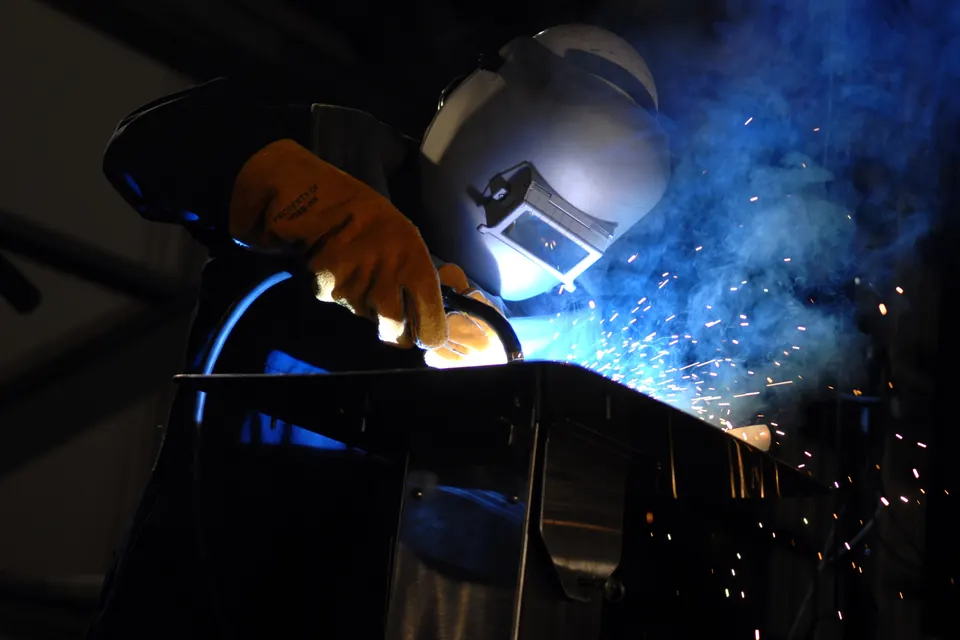
MIG, or GMAW, is wire welding. The welder holds a gun that feeds wire from a spool. The wire melts into the joint while gas from the gun shields it.
It's fast. Miller says wire welding can run up to four times faster than stick on farm repairs.
It covers a lot: from 24 gauge sheet up to 1/4 inch on car work, in steel, stainless and aluminum
Looks vary: more carbon dioxide in the gas means more spatter and a rougher bead
No slag with solid wire, though spatter may still need grinding
What TIG is
TIG, or GTAW, uses a torch with a tungsten tip. The tungsten makes the heat but doesn't melt into the weld. The welder adds filler rod with the other hand.
It's precise. The welder controls heat, filler and travel separately.
It handles thin metal, down to .010 inch with the right machine
It welds steel, stainless, aluminum and chromoly. Aluminum needs an AC/DC machine.
It's clean: no sparks, spatter or slag. The neat ripples are often called stacked dimes.
It's slow. Miller calls it much more time consuming than MIG on thin sheet.
Stick and flux core
Stick (SMAW): a rod coated in flux, held in a clamp welders call a stinger. The flux makes its own shield and leaves slag.
Flux core (FCAW): like MIG, but the wire is hollow and filled with flux. It leaves slag too.
Self-shielded flux core needs no gas bottle. Some flux core wires still use gas.
Outside and in the wind
Wind blows the shielding gas away and leaves small holes in the weld. So welders working outside often switch to stick or self-shielded flux core. Miller shows self-shielded flux core welding heavy steel piles on a jobsite.
If your job is outside, ask how the welder will deal with wind.
What it means for your price
TIG takes longer, so it usually costs more in labour
Some shops charge more an hour for it. One Texas mobile welder adds US$20 an hour for TIG.
MIG is the usual pick when speed matters and the weld won't show
Not sure? If either would work, ask the shop to price it both ways
Precision metal fabrication, machining and sheet metal work for customers including defence, with welding, powder coating and chemical conversion finishing.
Machining and sheet metal fabrication of prototypes, jigs, fixtures and production parts for aerospace, telecommunications and medical device customers.
Custom sheet metal fabrication, machining and powder coating for industrial, commercial and railway customers, from design and prototypes to production runs.